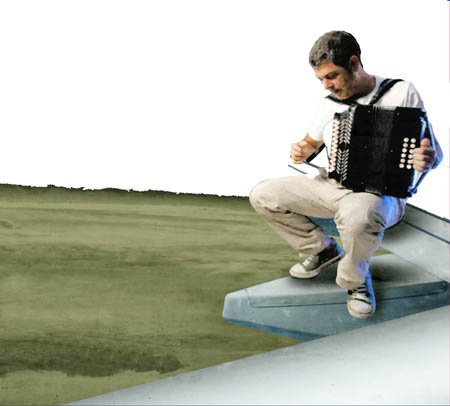
martes, 16 de noviembre de 2010

KEPA presents HERRIA his third, last, new album of the trilogy.


EITB KULTURA: Nov 16 2010


This time, the Basque accordionist has surrounded himself with musicians from U.S. A., Madagascar, Greece and Korea. In these new versions we will find folk, jazz, gospel and rhythms of the Indian tribes.


Today Kepa Junkera begin_of_the_skype_highlighting     end_of_the_skype_highlighting has presented his third and last new record HERRIA of his trilogy being first "Etxea" (2008) followed by "Kalea" (2009). The three records gather the traditional folksongs in euskera (Basque language), interpreted by musicians from outside of the Basque Country.

In Herria (Town), the Basque accordionist has surrounded himself with non Latin interpreters of musical cultures and having contact in the area of folk music. This new album includes 23 songs recorded in Paris, Istanbul, Casablanca and in the North American cities of New York, San Francisco, San Antonio, Los Angeles, Oakland, Boise and Hawaii.

The sounds are a slight different with new instruments", Junkera has said in the presentation of his new album in Bilbao. The record reflects the cities´ music’s of where it was been recorded, so that the Basque songs appears with versions as the rhythms of the Indian tribes, tex mex , with the musicians of Flaco Jiménez, jazz of New York by the hand of Dave Douglas´s quartet, gospel or the sound of the lyre, the ukulele or the wind instruments of Armenia and Turkey.

This project started off in 2008 with Etxea (House), in which Junkera surrounded himself with musicians of the Iberian Peninsula and the caribbean that they sang in euskera. Miguel Bosé, Ana Belén, Loquillo, Jaime Urrutia, Santiago Auserón, María del Mar Bonet, Estrella Morente, Michel Camilo and Dulce Pontes are some of the voices that took part in that first record.

In Kalea (Street), Latin American were the ones that interpreted and sang the Basque song: Juanes, Lito Vitale, Viticus, Pablo Milanés, Julieta Venegas ...

The trikitixa's interpreter has highlighted that in the three albums the participating musicians have had freedom to make of Basque folksongs "theirs" with "no limitations", although "the main thread is the strength of the Basque songs" and euskera. Junkera has thanked the writers José Saramago, who passed away last June, Bernardo Atxaga and Xabier Aumuriza for the prefaces that they made for these records.

Video-clip HERRIA Egun da Santi Mamiña

Video-clip : Trilogy ETXEA KALEA HERRIA


www.kepajunkera.com

jueves, 28 de octubre de 2010

HERRIA, the new album of Kepa Junkera


Kepa Junkera closes his Trilogy of the Basque Folk Music (started off with the albums ETXEA and KALEA) with the album HERRIA. From November 16 it will be available in a double CD and digital format, in Warner edition.

The recording of the 23 songs has be recorded in New York, Oakland, Berkley, Paris, Casablanca, Istanbul, Athens, Boise, San Francisco Los Angeles, Hawaii and Bilbao.

(Text from EFE EME published the 28 Oct, 2010 in the category Spain Records, News)

www.kepajunkera.com

Kepa Junkera makes the Bulgarian public fall in love with the Basque music


Sofia, 27 Oct. ( EFE).- The musician from Bilbao, Kepa Junkera, gave forth in Sofia a moving and unforgettable spectacle of rhythms and traditional Basque sounds that made the Bulgarian audience fall in love, totally unknown music in the Balkan country that tonight he presents for the first time.

During almost two hours the composer, producer and the artist did not stop provoking admirations on behalf of the majority of 1,200 spectators that have been hypnotized by the magic of his interpretation of trikitixa, a typical Basque diatonic accordion.

The "the king of the accordion" surpassed the challenge of attracting the public with this instrument known in the Balkan country as typical of the folkloric music, but with a completely unknown and contagious tonality.

In addition to this Basque accordion, the spectators also had a good time with other musical instruments like the txalaparta, a kind of percussion whose thick board is hit in pairs with four sticks, and also the alboka, a traditional instrument of wind.

Junkera that was awarded in 2004 with a Grammy for the best Folkloric album, The Bulgarian’s auditorium untied surges of applauses for his interpretation, well-known to have the best acoustics of The Balkans, and also to make a speech in Bulgarian’s language, winning his way to the public.

News published in the newspaper ABC.
27-10-2010 / 23:40 h

www.kepajunkera.com

jueves, 2 de septiembre de 2010

THE MOST UNIVERSAL ADVENTURE OF JUNKERA ( HERRIA )


The musician is finishing "Herria", the record that will close his trilogy of Basque songs. It’s his most international album and has recorded with American, European and African artists.


Although I miss that spirit, that sensation of discovering things when I was 10 years old, Kepa Junkera keeps on exploring new ways in the musical scene. These days he is finishing mixing the songs that compose the third music album of his trilogy. Herria will be released next month of November but if the musician doesn´t feel that the outcome is what he wanted then it will be released later.

After Etxea and Kalea, Kepa Junkera dashes to a most universal and cosmopolitan adventure. If for the first record he counted on state artists, for the second one he increased his influence to South America, in Herria he´s gone a little further crossing the Atlantic to go to United States. “I have recorded in Saint Francisco, Los Angeles, New York, in cities that are very opened, of encounter. And I wanted to finish with this type of cities, of more universal towns ", Junkera explains to who underlines the opening of this project.” It is very free way to face the musical and human encounter. What I look for is sharing these Basque folksongs and what they mean. Sharing our culture with people of other territories, of other musical visions ".

With the great acceptance that had his two first records of the trilogy, this third one promises. “I am very happy about the repercussion that they have had. This is a long term project. It will understood better within time. In spite of working with folksongs, it has that point of invention that is needed to be understood ", the native of Bilbao comments.

AMBASSADOR PROJECT If somewhat awakes our curiosity of this work is the multiculturalisms that he picks up. Artists around the world have brought their particular grist to the mill. People of Pakistan, of Korea, of Japan, Moroccan or of Madagascar, as for an European and American musicians.

And to increase the difficulty of the record, they all sang in euskera. " Many times, from inside, it seems to be a task more complicated. It would be if they offered me an interesting proposal to which I am not familiar with. Maybe, you face yourself from a positive view ", Kepa Junkera explains. The musician recognizes that the people at first moment are surprised but little by little they change that reaction toward a open new view point. “They take it as an honor. For them, it is a great satisfaction to be part in a culture that many know and for others that they have heard about". Junkera praises the work that his companions have done in Herria. "They start to know but them they implicate themselves more. They look for, they rummage and they are very excited about it." This union of cultures grants us a look of "an ambassador project” to the album, according to Junkera, he admits that among the three albums there are" more than 200 singers" from around the world.

And it is not a job of musicology where you look for the hyper-perfection in all the notes. “you always are going to have the accent, the bell. And it seems enriching to me that there is that variety ", explains.

So much wealth cultural contributes to very enriching shades. Songs of jazz, blues, all sounds have a spot. “We have to listen to it. I try that it has a connection, that they can´t be like separate islands although I give freedom ", stands out with the example of this theme, Egun da Santimamina, with the lyrics of Xabier Amuriza and Gabriel Aresti, to the one he was mixing upon this interview. "It is a theme recorded with the American Indians of different tribes and with the descendants of the Basques, of the Basque shepherds, that they are Americans.

A lot of new voices but also a lot of new instruments. "There are standard instruments like the piano or the drums but also other more strangers as the laúd, that is the Arab guitar, the Indian drum or the ney, that is a kind of flute", telling us Junkera and that increases this particular list with Turkish or Greek instruments like the lyre of Crete.

FUTURE Accustom to hook a project with another one, Kepa Junkera already has his eyes set on new ideas although among them it is not on a new trilogy. “I ´m in eager to finish this. It has been many years of work for me and I want to enjoy it but from a certain distance.” he assures. Although this affirmation is not reduced to only this work in which he has be submerged during 5 years. “It happens with all of them. I just need to detach from them".

And in order that that distance in relation to the trilogy becomes a reality, Kepa Junkera already thinks “in a recording a new album with my group, if everything is goes alright. I have done many projects in recent times. I will focus on that and in playing. I want to return more full”.

But those expectations do not center themselves only in composing a new record but also he has new experiences in mind. He’s also thinking about the possibility of presenting the trilogy in a pack and of the first record he already has a book. “I am open. In order to make it, I´m delighted. We have photos from Santi Yaniz to photographers of the whole world, very interesting for a book ", Junkera indicates who lengthens his vision of work.” I am with the documentary, since I have recorded the whole process in video. Let’s see if for the coming year we can do something ".

It’s more than 30 years of career with his trikitixa and Kepa Junkera and looks back and he is satisfied with the outcome. “I am very happy with what I have achieved. For me, in the beginning, this was a game. I had never imagined that I would be here”.

Published in the newspaper DEIA

www.kepajunkera.com

miércoles, 28 de julio de 2010

BETI BIZI interview by EiTB KULTURA


BETI BIZI is Kepa Junkera´s new project accompanied by Xabier Amuriza and the female voices of the choir KANTIKA.


On Monday an interview was recorded for the cultural program of the Public Basque Television (EiTB) "EiTB Kultura" with Kepa Junkera and Xabier Amuriza, writer / bertsolari (improviser of oral verses) explaining all the details of this new album BETI BIZI.

Also in the interview we could count on the participation of the girls from the choir "LEIOA KANTIKA KORALA" who joined in with the accordion music of Kepa Junkera and the voice of Xabier Amuriza interpreting several songs of the album.

The program was recorded in a unique setting such as the Nature Interpretation Center Tower Madariaga located in one of the most privileged spots of the natural park of Urdaiba, in Busturia.


It is believed that the interview will be showed on the 17th of August in ETB 2, in Spanish while the 19th of August it will broadcast in ETB 1 in Euskera, the basque language.


www.kepajunkera.com

miércoles, 7 de julio de 2010

The magician of the "trikitixa"


Published by Dani Chicano on July 6, 2010: www.avui.elpunt.cat
Foto de Lluis Serrat


After the concert on Friday night on the steps of Girona´s Cathedral, which Kepa Junkera offered, talking to with Miquel Basin, what is that you always enrich the conversation, a scholar in the field of music, and especially the has been called world music, in which in the traditional Catalan music that would be extremely well a figure that was the equivalent to Kepa Junkera in traditional Basque music. Junkera has achieved, among other things, which the trikitixa, Basque diatonic accordion linked to popular music and with a liberating function ceases to be a reviled instrument, frowned upon even by religious and social issues, usually related to rural and little academic places. The trikitilari from Rekalde understood that to maintain the tradition it needs to evolve, it must be renewed by applying a creative spirit. Shield against any alteration, to repeat over and above what can only be reliably lead to the disappearance or the relegation to the status of anthropological oddity. Junkera has recovered the trikitixa, but also the traditional Basque folk music and has adapted to the times, repeating this operation with the txalaparta and alboka, traditional Basque percussion and wind instruments, respectively, which together with the sound of trikitixa are the hallmark of Kepa Junkera and his group of excellent musicians. In Catalonia there are commendable efforts, such as Jordi Molina with the tenor, Artur Blasco (El Pont d'Arcalís), also accordionist with a long history and a lot of work of recovery behind his back, but none of the size, versatility and the international projection of Kepa Junkera, comparable to what has been done with the Galician gaita by Carlos Nunez, for instance. Just as Núñez and gaita (bagpipes), Junkera breathe the same rhythm as his instrument, which has an absolute dominance, spectacular, which allows him to play at a high speed without losing a single note, with vivid clarity. The symbiosis, perfect, allows to modular the speech to Kepa Junkera´s convenience, qualify it, to excite the public, who finished surrendered to him.


At the concert in Girona, Junkera, was accompanied by Iñigo Olazabal (Txalaparta, albota and percussions), Argibel Euba (txalaparta and percussions), Roberto Caballero (bass), José Luis Canal (piano) and José Ángel Telleria (drums). The majority of the songs played were from his album HIRI (2006)- Hiri, Kokkola, Buenos Aires, Reno, Agadir, Tatihou, Ataun and Napoli- in which Junkera, being an interpreter and composer, he was inspired by many cities of the world. The rest of the themes are from his album Bilbao 00:00 – (Bok Espok, Gaztelugatxeko) Maren -(Kaixarranka, Peliqueiroak terranovan) and Leon Orroeak (Zrkinipez)

www.kepajunkera.com

The sound of natural born innovators


A new step forward of the trikitixa


Amuriza, Leioa Kantika Junkera Koral and joining tradition and modernity in assigning "surprising"


Published by Ander Egiluz Beramendi for DEIA on July 4, 2010

Betibizi. Immortelle. It is the flower that is placed on the lapel of the dancers, and is the title of the new album with the signature of Xabier Amuriza, Leioa Kantika Koral, along with the inexhaustible Kepa Junkera. "The title has a double meaning," says the bertsolari of Etxano-“On one side is a direct reference to the flower of the dancers, a tribute to them all, and secondly the demand for the dance, of its vitality and eternity”.
The album, published by Hiri Records, has great coral presence, also having the trikitixa of Junkera and with the foundations on ancient ballad Biscayan´songs and classical melodies of dance that Amuriza has collected and sorted. But it does not sound as expected. The CD, shocks you, a lot. "People may be surprised," the musician of Rekalde sincerely says. "It's an album to enjoy listening to in a hi-fi system". And if anything characterizes the large group that has join together in this project- so many names that always one is always left behind, is the obsession for a work well done. "I've been very careful with this recording because I know how Xabier works and the time he has spent on its and I wanted to be at the height of the circumstances," says the trikitilari.

With a copy in his hand, Amuriza laughs from the little that the CD holds in comparison with the books in which, ten years ago, recovered the verses. "So much work and so little presence," jokes the two of them, with a very good reason: the first steps of the project were taken "almost nine years ago!”, exclaims Junkera.

The label market situation also is not at all buoyant and explains the musician, "it will become increasingly more difficult to make records like this, many years of work." But creativity can not stop on breaking down barriers.

Innovate

Beyond the triki and tambourine

What is most striking in the first electronic sounds heard that the artist used for this. The album is the second part of a project that Amriza began more than a decade, with the recording Bizkaiko kopla zaharrak, in which Tapia ta Leturia participated. On that occasion the result was more classic, "The Sound of lifelong triki with melodies and lyrics together forever," says Xavier. But for this second part I wanted to change the recording -there fits the idea of mixing dance tunes with other types of ballads-, and who became his traveling companion, Kepa Junkera, also soughing new atmospheres. "It has always caught my attention to play differently," honestly speaking Junkera. "Not always playing the triki with the tambourine."

The “hunger and appetite” got together, two natural born innovators, ground-breakers, each in his personal field. Xabier revolutionized improvisation by showing that it was not a privilege of gifted persons and Kepa did the same to bring trikitixa to dispute in the market, and often to pull it off, with the mass of radio pop formulas. On their innovative impulses Amuriza believes that "we must be daring." "Also, at that moment you do not realize the impact of those changes retrospectively. Perhaps we are looking too far into the future ...”


Kepa Junkera, despite of always seek new ways for that “infernal bellows” -like he called the triki in his first album, "it´s still thrilling ,in a special way, to hear the sounds of the most classic trikitixa: “Fasi, Epelde, Leon Bilbao... were persons with a special charisma and when I hear those sounds something stirs up inside of me." But this time, in addition to the innovations proposed by Xabier and the electronic bases, the guy of Rekalde "I wanted to do new things with the choir." And that's where Astulez Basilio comes in, the director of Leioa Kantika Koral, "a man who does an awesome job," according to Junkera. He was a great challenge for a choir because, for one, it meant to record separately and in one same microphone the alto, bass ... But the final result has been impeccable. "It's exciting to see a group of girls so young and so serious liking to do new things," says Junkera.


This type of projects "stimulate the imagination and inspiration and making you enjoy it," says rekaldetarra (a person born in the Rekalde) proudly looking at the CD. "And that is important," he adds. Both artists agreed that sentimentally finishing the job "it´s a pride." To which Kepa adds that Betibizi "it´s an album that gives us fresh air." New and innovative. Something about what Amuriza reconsiders in the preface of the album: "The effect has been fascinating." It will cushion the effect for the conversion of novelty in practice?” Not so. May it continue to open new paths, even if the circumstances appear to be adverse. A great album.

www.kepajunkera.com